
Let’s Talk About Revolver Cylinder Throats
These posts are written by me, not AI. Unless otherwise stated, all pictures were taken by me as well. Please enjoy.
Revolvers have always fascinated me. When properly built and tuned, they’re hard to put down.
When my Smith & Wesson 629-9 Mountain Gun came in I was very excited. I had always wanted a 44 Magnum Smith, and this new offering from Lipsey’s, without the lock, fit the bill. I decided that I would use this platform to build what I would call my “ultimate woods revolver.”
I did all of the standard stuff when I first received it, polishing up the internals to smooth the double action pull, filing the stocks to fit my hand perfectly, and shooting it as much as I could. I primarily shot a mild .44 load that my uncle uses as a woods carry load, 250 grain Keith bullet moving 1,050 fps, it was a delight to shoot. However, I started to get some heavy leading right off the bat, and accuracy was just ok with 2 1/2 inch groups at 25 yards.
These were hard cast bullets so I knew that lead softness wasn’t the issue. Alignment was perfect as well, so it wasn’t that. It had to be the cylinder throats.
Some of the links on this site are affiliate links, which means I may earn a small commission if you choose to make a purchase—at no additional cost to you. This has no impact on what I write about or the opinions I share, as everything here is based on real use and time in the field. I only include links when I believe they genuinely add value or help the reader, and I won’t recommend or link to anything I wouldn’t use myself.
Throughout this article I will be referencing the book The Custom Revolver by Hamilton Bowen. He is widely considered one of the best when it comes to custom revolvers. If you have any interest at all in custom revolvers, the ebook is well worth the $10. Physical copies of his book are expensive on the secondary market, although it has been rumored that there will be another run in the future.
What is a Cylinder Throat?
The cylinder throat is the part of each chamber that is directly in front of the chamber itself. In a firing sequence, the bullet leaves the brass casing, passes through the cylinder throat, jumps the cylinder gap into the barrel forcing cone, then travels down the length of the bore until it exits at the muzzle.
As you can see, the cylinder throat is the last thing that the bullet passes through before it enters the barrel. Its job is to present each bullet with the proper diameter and alignment. Every throat should be the same diameter for a revolver to shoot its best.
Hamilton Bowen explains it better than anyone:
“The basic mechanical requirements for an accurate revolver are — at least in theory — a good barrel, adequate cylinder-to-barrel alignment and proper throat diameter relative to the barrel groove diameter.” (The Custom Revolver)
How Cylinder Throats are Measured
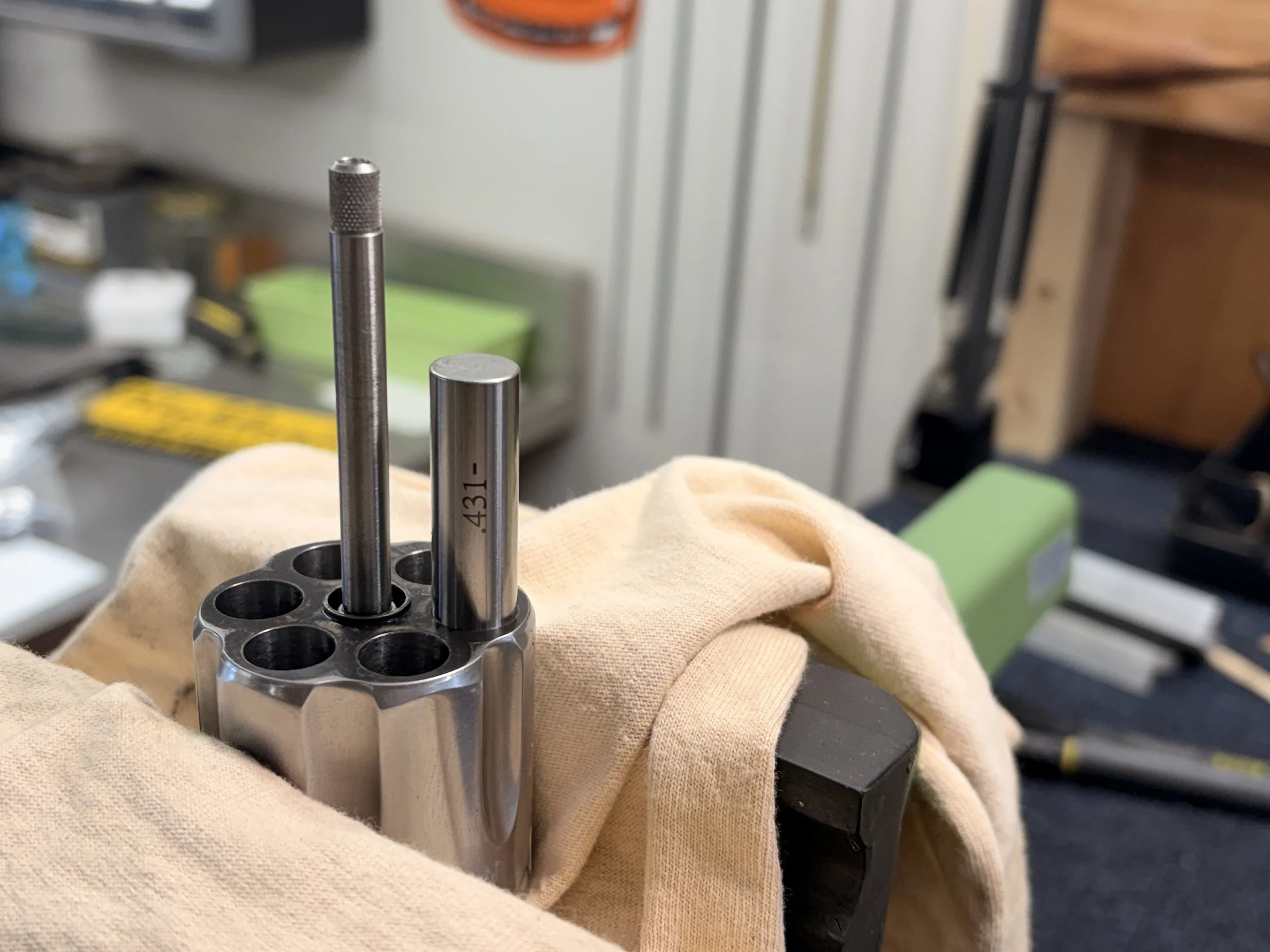
Cylinder throats are measured using minus pin gauges. Pin gauges are precision ground pins that are ground at a certain diameter. Full sets are pretty expensive and not typically owned by the hobbyist, but are extremely useful to a gunsmith.
These pins are lubed up with a light coat of oil and inserted into each throat. You go up in 0.0005” increments until you find the size of the throats. You have to check each throat as many times they are inconsistent from the factory. Make note of each throat’s size.
Ideally, your cylinder throat should be 0.001-0.002” over groove diameter. How do you know bore size?
Bore size is most accurately measured by slugging the bore with lead, or pushing a tight fitting piece of lead through the bore and getting a measurement of the diameter.
Bullet Size Is Important!
If you reload for a revolver, you know this. When buying cast bullets there are tons of options for bullet diameter for this reason. Knowing what your bore diameter is can help you select the right bullet diameter. It is important to note that if your bullets aren’t the proper size you won’t get the full benefits of having properly sized throats. For cast bullets this should be at bore diameter or 0.001” larger than bore diameter. So if your bore measures 0.430”, it is recommended to use 0.430-0.431” diameter bullets.
“Bullet-to-cylinder throat fit is critical and cannot be over emphasized. Started from the rear of the throat, naked bullets ought to pass through the throat with only modest resistance. Light taps on the bullet heel with a mallet and wooden dowel should be about the maximum effort required. Bullets should never be larger than the cylinder throats.” –Hamilton S. Bowen, The Custom Revolver
Undersized Throats
Undersized throats on new factory revolvers are far more common than oversized ones. While undersized throats hurt accuracy, they’re easier to correct than oversized ones.
When you have an undersized throat, the bullet is swaged down as it leaves the cylinder. As this undersized bullet enters the barrel, gases from the propellant leak around the bullet heel, melt the bullet lubricant and causes heavy lead fouling. Exactly what I was experiencing with my revolver.
Signs of an undersized throat include: leading, inconsistent velocity, and flys in groups.
Oversized Throats
Oversized throats are much more difficult to correct as they can not be corrected without replacing the cylinder. Instead of swaging the bullet down, the bullet isn’t properly aligned entering the bore. While the forcing cone will pickup some of the work, you may see less consistency in your groups.
According to Hamilton Bowen, “If bullets fit loosely in the chamber throats, they tend to tip slightly and don’t enter the forcing cone point on. They are likely to be more deformed and out of square when they depart the muzzle and less likely to fly straight.” (The Custom Revolver)
Properly Sized Throats
As mentioned earlier, a properly sized throat is 0.001-0.002” over bore diameter, consistent across all chambers. When you have a properly sized throat, used in conjunction with the right sized bullet, you should experience exceptional accuracy and little to no leading.
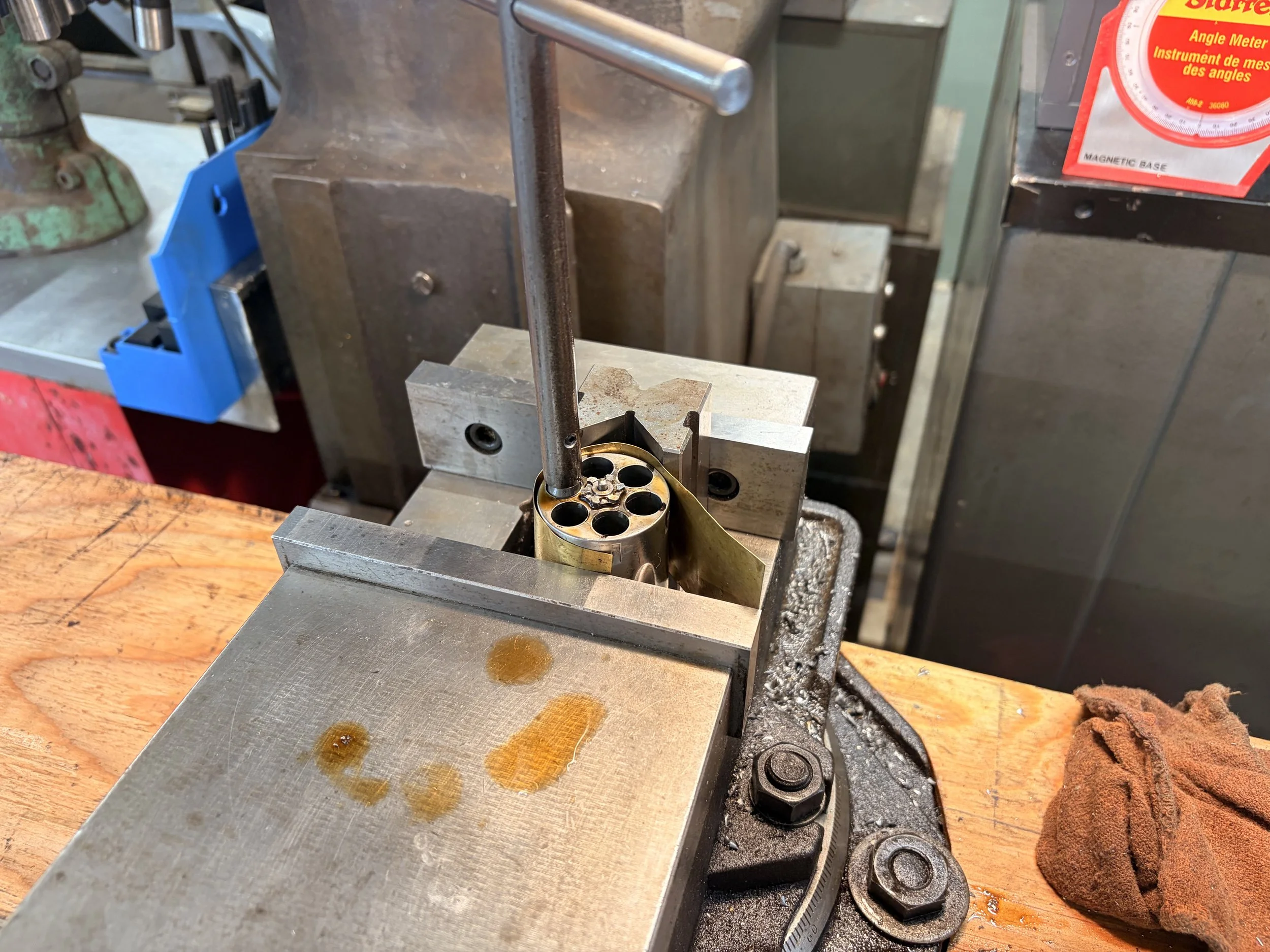
Reaming a 44 Magnum cylinder
How I Correct Cylinder Throats
If a cylinder throat is oversized, there isn’t much I can do as I do not have a source for blank revolver cylinders. If your throats are undersized, there is a very straightforward fix.
After using gage pins to measure and determine what each individual cylinder throat measures out to. I use a piloted reamer to ream the throats out to the proper dimension. The pilots are fit to within 0.0005” creating a snug fit, reducing the chances of encountering chatter. Tons of cutting oil and steady pressure create a clean cut.
It is never easy to ream a hole 0.001-0.002” larger than it is. So this process does not produce a polished appearance. Polishing it out can do more damage than good, so they are left in the condition they are in. It is not rough by any means, but if closely inspected you will see some marks from the reamer. However, there is no indication that this effects accuracy in any way.
Final Thoughts
Not every revolver needs its cylinder throats corrected. Being the type of people we gun folk tend to be, we are always trying to push the limits and get the best results possible. This means that we sometimes make up problems that don’t exist.
I can’t guarantee that correcting your cylinder throats will improve the accuracy of your revolver, but I can say that it definitely won’t hurt it.
If you’re happy with how your revolver shoots, leave it alone. Measure when there’s a problem not just because you can.
Written by: Kurt Martonik
Kurt is a Gunsmith, Reloader, Hunter, and Outdoorsman. He grew up in Elk County, Pennsylvania, where he became obsessed with the world of firearms. Following high school, Kurt enlisted in the United States Air Force as a Boom Operator, where he eventually rose to the position of Instructor. After his military service, he attended the Colorado School of Trades(CST) in Lakewood, CO for gunsmithing. Following graduation, he accepted a job at C. Sharps Arms in Montana, where he worked as a full time stockmaker and gunsmith. He now owns and operates Highland Custom LLC. See full bio here.
